I havent heard of the M14 though. Is it like the M16 but with more power, and lower fire rate? I'd like to know more about it.
The M14 had more power because it was designed with the 30.06 round in mind, but it was later changed to handle NATO rounds of the time, which are more powerful than NATO rounds now. I think it lacked in automatic firing rate, but performed above expectations in every other field. Although John Garand only had minor consulting where it was developed, it is the evolution of the M1 into a fully-automatic weapon. It was adopted by the military briefly during the Korean War, but the M1 took over as Vietnam approached, partially based on political and military mindset reasons.
Also, do the Marines use the M1? Or they just use it in parades and demonstrations they do? I've seen a lot of videos on youtube, and on TV, with some Marines in line, doing "tricks" with the M1. (Stupid question, I know )
As I told you before, questions are how we learn. No, the marines do not make service use of the M1. The drill rifles are maintained for ceremonial use with the marines, national guard, and others. Drill rifles have their gas cylinder lock screws welded to lock and gas cylinder. The barrel is drilled, plugged and welded at chamber mouth. The barrel is welded to the receiver and the firing pin hole is welded closed on the bolt face. They can not fire.
Banned for replacing children with weaponry.
Allow me to clarify. He has two sons who were with him when he passed away shortly after his wife died. He loved them all very much. The M1 he cherished was assigned to him while serving as a sniper during the Korean War, one of the most notable of his experiences being at Heartbreak Ridge. He cherished the weapon because, much like another soldier, it was there for him and took care of him in the field of battle, an experience very few outside of veterans understand. The weapon was turned in at the end of the war and the Garand Collector's Association saw fit to recover the rifle and present it to him in thanks for his service. His sons now take care of the weapon.
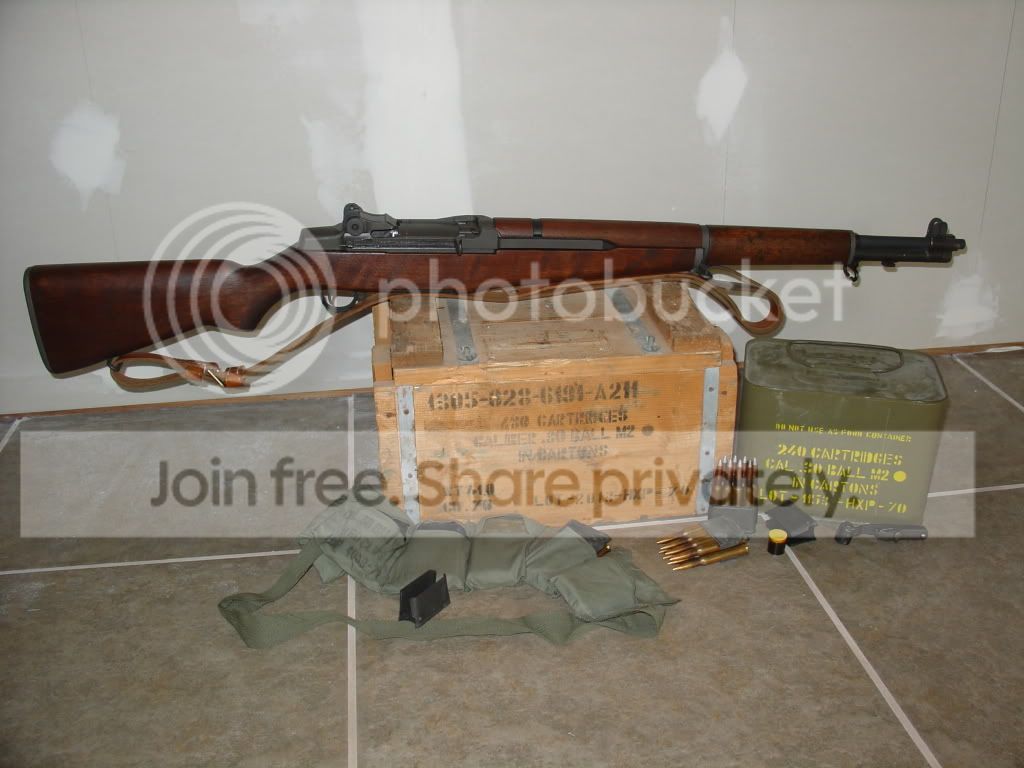
And now for pictures! I quickly assembled a small portion of my equipment. The rifle is an M1 produced late during WWII, refitted before service in the Korean War, and then refurbished at San Antonio Arsenal. I refurbished the wood once more. The ammo crate it sits on is of Greek origin, from 1970. It contains two spam cans of M2 ball ammo similar to the one to the right of the crate. M2 ammo is lead bodied with a steel shell to prevent deformation during flight, thus making it armor piercing. The green belt is a Greek bandoleer with cardboard inserts and loaded en bloc clips, of which there are two empty and two loaded nearby. The clip with the silver tipped bullets is loaded with incendiary ammo. The small tube next to the incendiary ammo is a yellow capped container of heavy grease, used to lubricate the operating rod slide, which faces the camera. Next to that is a multi-tool, equipped with a screwdriver to unscrew the gas cylinder (front underside of the barrel), a cylindrical tab used to push out several internal components, and a specialized head to open the entire bolt with one twist.